We are pleased to invite educators, researchers, practitioners, advocates, policymakers, and members of the Deaf and Hard of Hearing community to submit abstracts for the Deaf Education Conference 2026, held by the University of the West Indies, St Augustine Campus, School of Education. This conference will provide a platform to share innovative research, strategies, and best practices to create inclusive educational environments and empower individuals who are Deaf or Hard of Hearing and will feature stage and poster presentations, workshops, and an expo/fair.
Our goal is to foster transformative change across the Caribbean and other regions, aligning with principles of inclusive education and human rights. We encourage submissions from a range of disciplines and professional backgrounds. Abstracts should clearly demonstrate how your work aligns with one or more of the conference themes, emphasizing the significance and practical applications of your findings.
Conference Theme
Pathways to Inclusive Education and Human Rights for the Deaf and Hard of Hearing:
Empowering Change in the Caribbean and Beyond
Sub-Themes:
(click for sub-theme details)
(hover over sub-theme for more details)
Inclusive Practices in Deaf Education
Inclusive Practices in Deaf Education
Focuses on strategies and frameworks to create inclusive and equitable educational environments for deaf and hard-of-hearing students, emphasising accessibility and support at all educational levels, including ECCE, primary, secondary, and tertiary education.
Literacy Development for Deaf Learners
Literacy Development for Deaf Learners
Explores methodologies and best practices for developing literacy skills in deaf and hard-of-hearing students, addressing the unique challenges they face in acquiring reading and writing skills.
Advocacy and Legislation for Deaf Rights
Advocacy and Legislation for Deaf Rights
Examines existing legislation impacting the rights and education of deaf individuals, highlighting the role of parents and students in advocacy efforts, the role of policy in promoting inclusion and equity, and grassroots movements and community engagement.

Sign Language Access and Interpretation
Sign Language Access and Interpretation
Addresses the importance of sign language interpreting in educational settings, discussing training for interpreters and the role of sign language in facilitating communication.
Health and Wellness in the Deaf Community
Health and Wellness in the Deaf Community
Discussions on accessibility and support emphasise the need to address health challenges within inclusive educational frameworks.
Addressing Gender Issues in the Deaf Community
Addressing Gender Issues in the Deaf Community
Explores gender dynamics within the deaf community, focusing on the unique experiences of deaf women and girls, as well as intersectional issues related to gender and disability.
Professional Development for Educators and Support Staff
Professional Development for Educators and Support Staff
Covers training programmes for teachers and teacher aides, equipping them with the skills needed to effectively teach and support deaf students in various educational settings, including ECCE, primary, secondary, and tertiary education.
Crisis Management and Disaster Preparedness in Deaf Education
Crisis Management and Disaster Preparedness in Deaf Education
Discusses strategies for preparing deaf education systems for crises, including emergency preparedness plans tailored to the needs of deaf students, with attention to health challenges they may face.
Lessons Learned from COVID-19 in Deaf Education
Lessons Learned from COVID-19 in Deaf Education
Reflects on the challenges and successes faced by the deaf education community during the COVID-19 pandemic, identifying lessons learnt and future directions for resilient educational practices.
Exploring Deaf Identity: Cochlear Implants, Speech Therapy, and Language Use
Exploring Deaf Identity: Cochlear Implants, Speech Therapy, and Language Use
Investigates diverse perspectives regarding cochlear implants, speech therapy, and the use of native Caribbean sign languages, addressing issues of identity and language deprivation.
Leadership and Empowerment in Deaf Education
Leadership and Empowerment in Deaf Education
Focuses on developing leadership skills within the deaf community, emphasizing the importance of deaf learners in advocating for inclusive practices and shaping educational policies.
Conference Languages
If presenters wish to present in a language other than the conference languages, we will ask them to provide interpreting into one of the conference languages. We will provide the interpreting between TTSL/ASL and English to ensure that all presentations are accessible in both conference languages.
The conference languages are English and Trinidad and Tobago Sign Language (TTSL)/ American Sign Language (ASL). If presenters wish to present in a language other than the conference languages, we will ask them to provide interpreting into one of the conference languages. We will provide the interpreting between TTSL/ASL and English to ensure that all presentations are accessible in both conference languages. All conference delegates will need to indicate the language that will be used in their presentation at the time of submission of their abstract and any arrangements to ensure accessibility in at least one of the conference languages. You may update us of any changes using the conference email: STA-CDEC@sta.uwi.edu
Please note that there is a planned Trinidad and Tobago Sign Language (TTSL) workshop at the start of the conference that will be open to all delegates who sign up for it.
Abstract Guidelines
We encourage submissions from a range of disciplines and professional backgrounds. Abstracts should clearly demonstrate how your work aligns with one or more of the conference themes, emphasizing the significance and practical applications of your findings. Requirements of Abstract Submission:
For Empirical Research
- Background: description of the problem
- Purpose: research objectives, research question(s) and/or hypotheses
- Design and Methods (where applicable): research design, sampling strategy, description of participants, data collection procedures and instruments, data analysis approaches
- Findings (if available): summary of specific results
- Conclusions and Implications: main outcome(s) of the research (if available), implications for practice, policy or further research
- Keywords: up to 5
For Non-Empirical Research
- Topic or Central Theme: clear statement of the topic or central theme
- Overview: a brief overview of the key points to be discussed
- Theoretical Framework (where applicable): the theoretical framework or perspective being used
- Unique Contribution: summary of specific project or intervention and relevance to conference
- Conclusions and Implications: main outcome(s) or potential implication for practice, policy or research
- Keywords: up to 5
Abstract Submission Guidelines
Abstracts should be no more than 400 words and may be submitted by individual researchers or research groups. Presenters are limited to three abstracts. We will accept abstracts related to successful innovative projects that have led to positive outcomes in the field of education of the Deaf and Hard of Hearing.
We also invite abstracts specific to workshops in the areas of reading, writing, advocacy, teaching discipline-specific content, and other areas related to the conference sub-themes.
Abstracts are due February 15, 2026, and we will aim to confirm the result of the peer-reviewed process by April 2nd, 2026.
Please complete the Abstract Submission Form below and upload your files where indicated. Once all fields are complete, click “Submit” at the end of the form to finalize your submission.
Thank you for contributing to this engaging and impactful event. We look forward to your submissions and to a collaborative exchange of ideas that will drive the future of Deaf Education in the Caribbean.
Sponsorship for PhD Students and Graduates
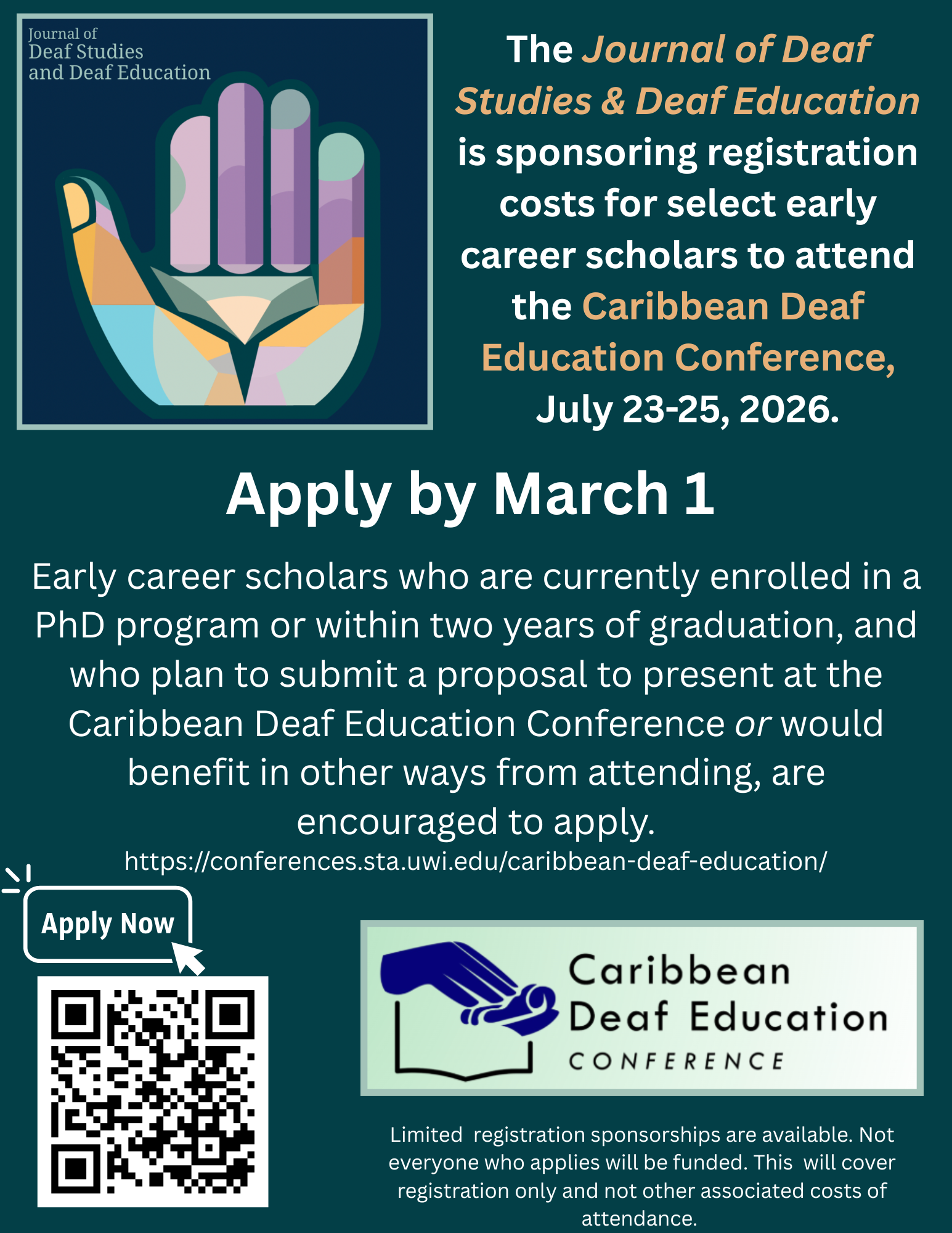
The Journal of Deaf Studies & Deaf Education is sponsoring registration costs for select early career scholars to attend the Caribbean Deaf Education Conference.
Early career scholars who are currently enrolled in a PhD program or within two years of graduation, and who plan to submit a proposal to present at the Caribbean Deaf Education Conference or would benefit in other ways from attending, are encouraged to Apply by March 1 2026
Please note that a limited number of registration sponsorships are available. Not everyone who applies will be funded. The coverage provided to those who receive it will cover registration only and not other associated costs of attendance (e.g., transportation, hotel room costs).
Please only apply if you will be able to cover these related costs via another source, like your educational institution.